You can do hard things

Month: October 2026

Blanket Exercise – Dr. Daniel Sims

Kairos Blanket Exercise

In this class we participated in The Blanket Exercise which was guided by Dr. Daniel Sims. This was an impactful physical representation of the history of Indigenous People throughout the colonization of Canada.

As this activity covered history that most of us in the class were already aware of, participating in The Blanket Exercise was very different from learning in a lecture or a book. The exercise started with blankets laid out all over the floor and we were asked to sit or stand on the blankets. Some students were also given coloured cards. As the activity progressed, we were told stories of what Indigenous people faced in the past, and as these stories were told we, the indigenous people for the sake of the activity, began leaving the blankets. Blankets were folded and removed as Indigenous people were displaced from their land, and as this happened, we either had to squeeze onto other blankets or leave the activity altogether. One of the most shocking steps in the story was when everyone with white cards had to leave the activity as their lives were taken by diseases that were brought over from Europe – seeing the amount of people that had to leave the activity at this time was overwhelming. It was heart breaking to observe children being moved to separate blankets representing residential schools, only to be returned back but without knowledge of their culture or family anymore.

After the activity we participated in a sharing circle. Many students with Indigenous families and friends expressed deep feelings of how hard this activity was for them as they had to see and feel what has caused their family and friends so much trauma, and see how resilient they had to have been to make it to todays world.

This activity was powerful for me as it was a physical and emotional experience that we participated in – helping us feel a tiny piece of what Indigenous people must have felt over the years.
West Lake Provincial Park – Oct 5th, 2026

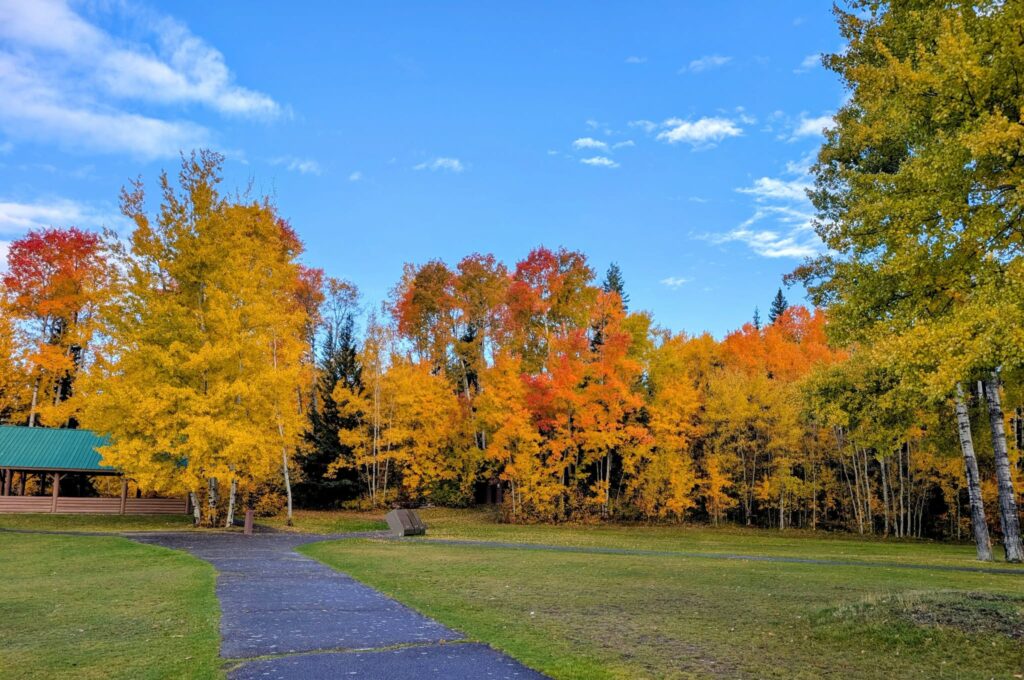
Wow! That a fantastic day at West Lake Provincial Park. We started by finding our sit spots from “Me and My Sit Spot” by Lauren Mclean, reviewed Land Acknowledgments and the First Peoples Principles of Learning, and ended with a “Walking Curriculum” by Gillian Judson.

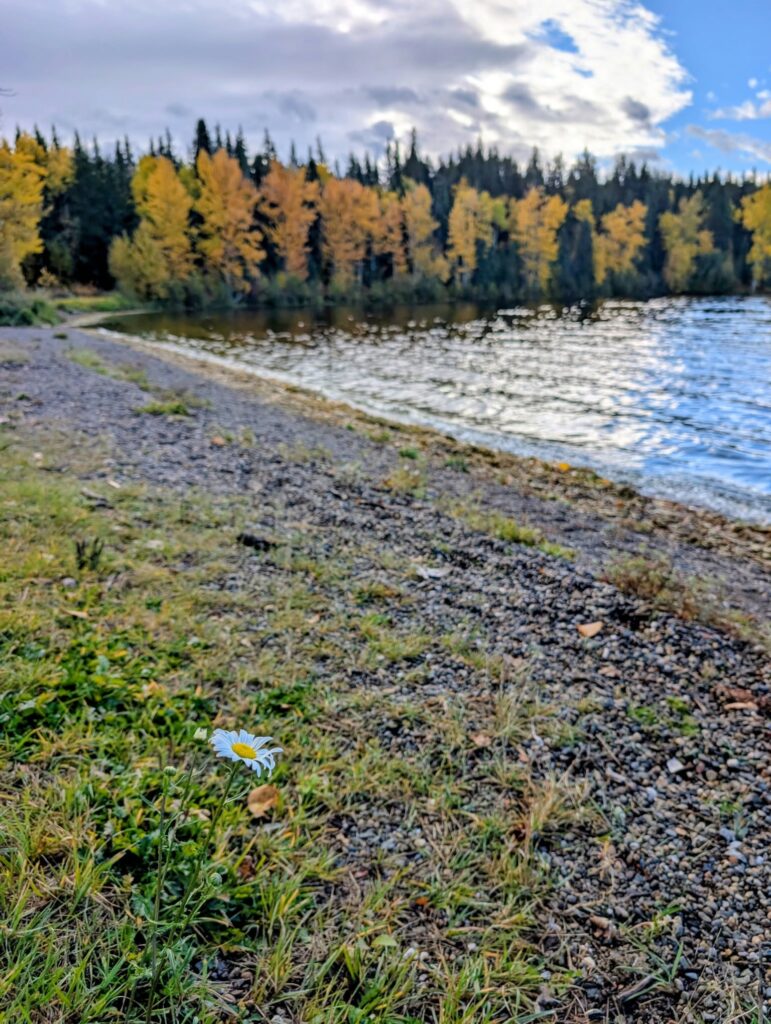
I found a sit spot looking out over the water where I could see the beautiful golden yellow of the leaves reflected on the lake. I remember in the story the child talked about how as she sits in nature she begins to slowly notice more and more around here. After about 7 minutes sitting in my spot I looked down beside me and noticed white daisies that I didn’t even know were there when I sat down. I found this an amazing representation of what we notice when we sit quietly for a period of time. I felt connected, alive, and open to learning.

I loved reviewing the “Reconciliation in Land Acknowledgments” pamphlet that was shared with us from the 2024 UNBC B.Ed. Cohort. I particularly enjoyed the poem Land Acknowledgement that it used in Primary schools in SD57.

“Here is the land

Here is the sky

Here are my friends

And here am I

We thank the Lheidli T’enneh

Whose land we work on and play

We promise to take care of it

Each and every day”

I find that this is a beautiful way to make a Land Acknowledgment personal, relatable, and understandable to children. This poem and the whole pamphlet did a wonderful job of explaining the meaning behind a Land Acknowledgment, how to make it personal and meaningful – not just a set paragraph that we recite.

Lastly, we participated in “A Walking Curriculum” by Gillian Judson. This consisted of a series of activities that had us connect to land in meaningful ways. My favourite activity was all about movement. It asked us to walk around and observe movement with our eyes and then imitate it with our bodies. It also invited us to observe how we know there is movement without seeing it with our eyes. For example, the sensation of the wind or the sound of leaves rustling. I feel like this was a really fun activity that students would enjoy.

I greatly enjoyed this beautiful fall morning at West Lake learning from the land. I am so grateful to live, learn, and play on the land of the Lheidli T’enneh. When I am outside learning I feel happy, awake, and amazed at the beauty around me. I hope to take some of these practices into my classroom someday.

Beaded Tweets – Indigenous perspectives & knowledge in BC’s Curriculum

Noelle Pepin was an absolute inspiration. Her work with beaded tweets is fascinating, relevant, and thoughtful. As we have been learning about the importance of Standard 9 and integrating Indigenous knowledge into our classrooms, having this example of how Noelle has done this perfectly was a wonderful learning experience for me.

I think one of the most important things I have learned so far about how to include Indigenous knowledge in my classroom is that it should not just be a lesson here and there. We should be finding ways to add Indigenous knowledge into every subject area on a daily basis. Nolle did this seamlessly when she combined binary code from Applied Design, Skills, and Technologies (ADST) with Indigenous beading. She also then took it one step further by calling it “Beaded Tweets”, which I think this was a beautiful way at merging modern internet culture with an Indigenous cultural art form. I feel this makes it relatable for all students.

It was fascinating to learn about how she has now taken this work and shared it with so many different classrooms and age groups. She showed us how her original project used a loom to make beautiful 8 strand beaded tweets. Then she shared examples of how she has used this in classrooms and how they have used a single strand to make it assessable and easy to practice with minimal supplies. She also shared examples of using a single letter, a word, or a phrase depending on the age group and the time that was available. I loved how she has options of different sized beads for different age groups, and how she even did a giant one with foam beads with a whole kindergarten class in a circle.

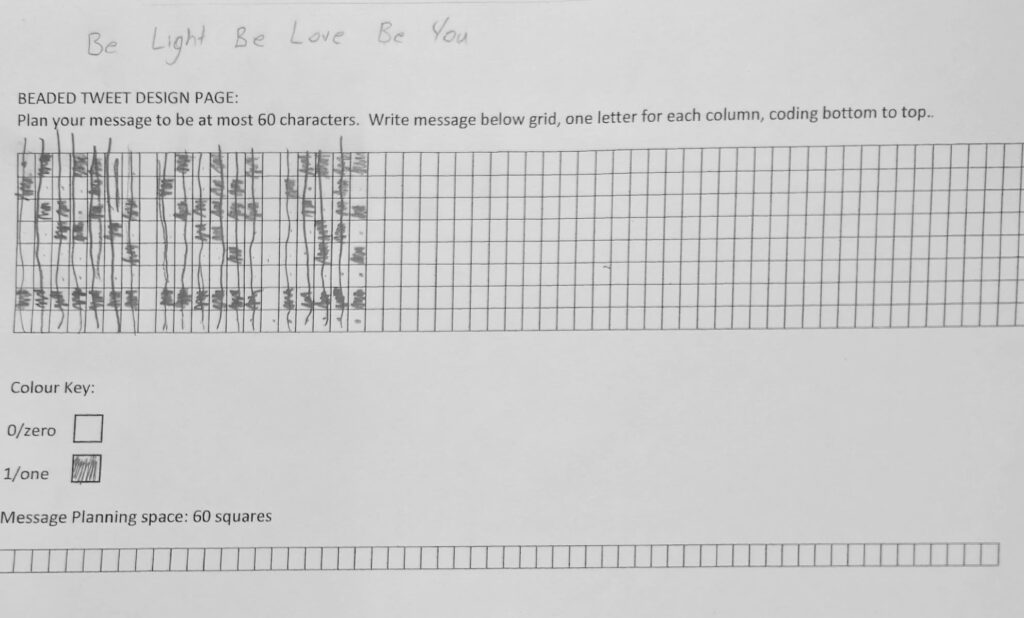
Noelle then showed us how to use the coding to make our own beaded tweet. She invited us to make something to gift to someone and shared her knowledge about how the energy and feelings you put into your work will be received when you gift that project with intention. I had so much fun making a single strand necklace for my friend that said “Be Light, Be Love, Be You”, so that she can take it with her as she begins her journey as a teacher.

This was one of my favourite classes so far. I would love to have Noelle in my classroom or have her permission to share these activities with my classes someday. I can only dream that once I am a teacher, I will be able to find ways to combine Indigenous knowledge and ways of knowing into the BC Curriculum as beautifully as Noelle has.

Powered by WordPress & Theme by Anders Norén