Noelle Pepin was an absolute inspiration. Her work with beaded tweets is fascinating, relevant, and thoughtful. As we have been learning about the importance of Standard 9 and integrating Indigenous knowledge into our classrooms, having this example of how Noelle has done this perfectly was a wonderful learning experience for me.
I think one of the most important things I have learned so far about how to include Indigenous knowledge in my classroom is that it should not just be a lesson here and there. We should be finding ways to add Indigenous knowledge into every subject area on a daily basis. Nolle did this seamlessly when she combined binary code from Applied Design, Skills, and Technologies (ADST) with Indigenous beading. She also then took it one step further by calling it “Beaded Tweets”, which I think this was a beautiful way at merging modern internet culture with an Indigenous cultural art form. I feel this makes it relatable for all students.
It was fascinating to learn about how she has now taken this work and shared it with so many different classrooms and age groups. She showed us how her original project used a loom to make beautiful 8 strand beaded tweets. Then she shared examples of how she has used this in classrooms and how they have used a single strand to make it assessable and easy to practice with minimal supplies. She also shared examples of using a single letter, a word, or a phrase depending on the age group and the time that was available. I loved how she has options of different sized beads for different age groups, and how she even did a giant one with foam beads with a whole kindergarten class in a circle.
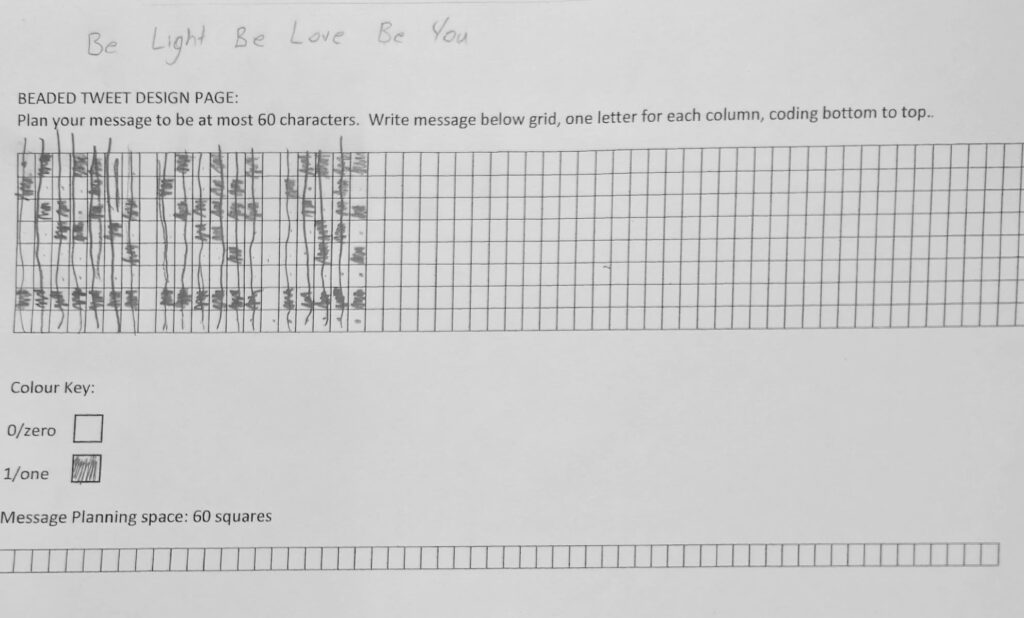
Noelle then showed us how to use the coding to make our own beaded tweet. She invited us to make something to gift to someone and shared her knowledge about how the energy and feelings you put into your work will be received when you gift that project with intention. I had so much fun making a single strand necklace for my friend that said “Be Light, Be Love, Be You”, so that she can take it with her as she begins her journey as a teacher.
This was one of my favourite classes so far. I would love to have Noelle in my classroom or have her permission to share these activities with my classes someday. I can only dream that once I am a teacher, I will be able to find ways to combine Indigenous knowledge and ways of knowing into the BC Curriculum as beautifully as Noelle has.